
The biannual Oral History Review (OHR) is the U.S. journal of record for the theory and practice of oral history and related fields. It is published by the Oral History Association housed at Baylor University. The current editor is Holly Werner-Thomas. You can reach her via email at . For more information about the journal and to subscribe, see About the Oral History Review. To submit a research article, please see the Article Submission Guidelines. For inquiries regarding submitting reviews for our book and media sections, see Book and Media Review Submissions. And if you have an idea, notice, or question, for OHR Extra!, our online content publication, please contact the Media Review Editor Bud Kliment via email at .
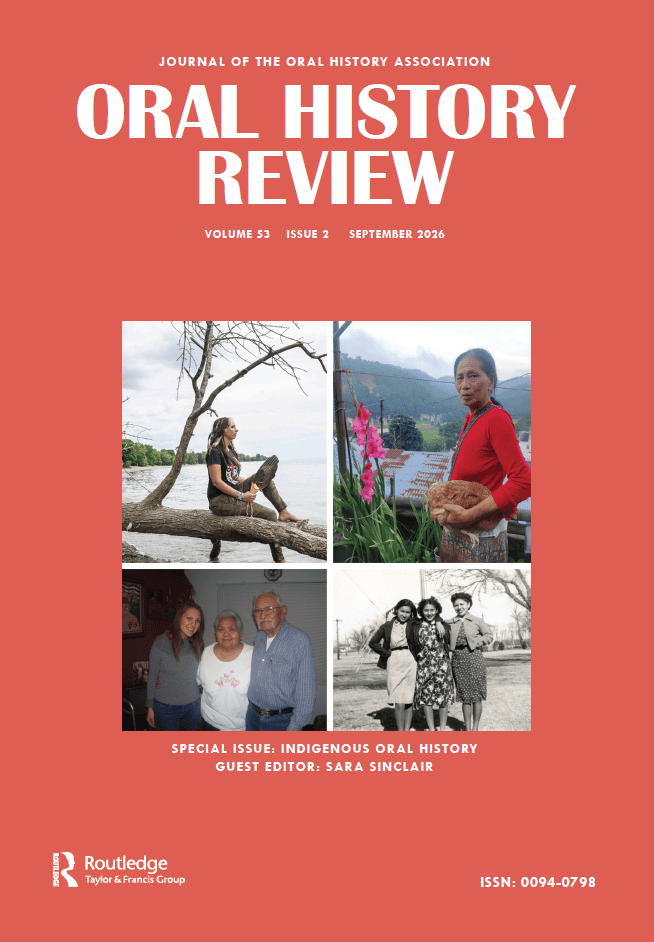
About the latest volume (53.2)
The fall 2026 issue of Oral History Review gathers a remarkable collection of voices from across Indigenous oral history as it is practiced today, spanning geographies, epistemologies, communities, and nations. This special issue takes as its animating premise that Indigenous oral history is not a technique for preserving the past but a living practice of relation, accountability, and continuity that holds governance, land relations, cultural memory, and health across generations.
Readers will encounter Mi’kmaw oral history as living law, Diné oral history as intergenerational teaching, Lūchūan and Kanaka ʻOwi frameworks of relational responsibility, and Apurinã narratives in which ancestors are active subjects of the present landscape. Other essays bring these ideas to bear on methodology, pedagogy, archival ethics, and the relationship between oral history and intergenerational harm and healing.
The issue also features book and media reviews ranging from new releases, including Julian Brave NoiseCat’s We Survived the Night and the second edition of the Indigenous Oral History Manual, to classic works revisited, among them Robin Wall Kimmerer’s Braiding Sweetgrass and Leslie Marmon Silko’s Storyteller, as well as reviews of digital tools shaping the future of Indigenous archival practice.
Taken together, these contributions bring Indigenous oral historians into sustained conversation with one another. The invitation extended here is for all oral historians to engage with what that conversation reveals.
Note: OHA members receive digital access to the Oral History Review, current and past issues (back to 1973). Members can also opt in to receive print issues of the journal twice a year.*
- Individual Members
- Online access to the journal is available to individual members through the OHA member website. Members log in and select the OHR Online tab on the member menu to reach the OHR archive hosted by Routledge, Taylor & Francis. To join and receive the journal, visit the OHA member website.
- Institutional Subscribers
- Online access to the journal is available to institutional subscribers on the Routledge website.
*Several Oral History Review articles are also available through Open Access contracts. Look for the orange tab with the unlocked lock icon or search the Oral History Review via the “Open access articles” tab on the left-hand menu.