
Announced by the OHA at their annual meeting in Atlanta, the Mason Multi-Media awards recognize “outstanding oral history projects, collections, exhibits, and multimedia presentations for the public.”
According to Yolanda Hester, who chaired the committee that selected the winners and whose members included Max Peterson, Mark Caltrain and Simona Tobia, “As in previous years, we were enthusiastic with the many exceptional projects that were nominated. They reflect the use of oral history across a variety of media platforms and applications, from art and film projects to digital exhibitions and collections. The nominations demonstrate the broad spectrum of scholarly and creative interests in oral history practice. And although the quality of the submissions made our job hard, we are thrilled to share that the Mason Award was given to three standout projects.”
Here are the projects:
Christopher Pandza and Madeline Alexander, “I See My Light Shining: The Baldwin-Emerson Elders Project”
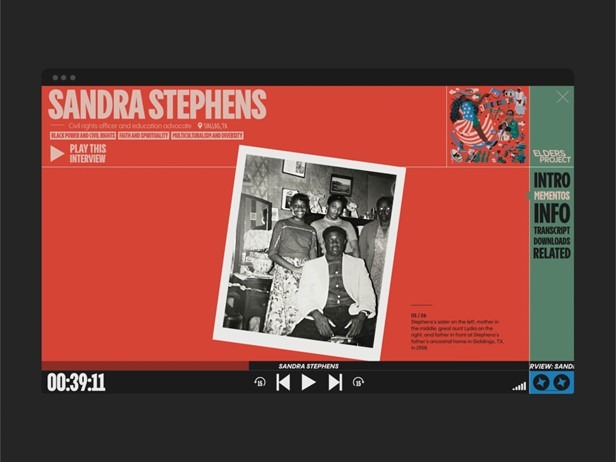
From Madeline Alexander and Chris Pandza:
Established by award-winning author Jacqueline Woodson, the Baldwin-Emerson Elders Project captures and celebrates untold and underrepresented stories of activists, storytellers, and community builders who have witnessed and shaped great change in American public life. Bringing together over 230 oral history interviews and 1,000 personal mementos from ten distinct communities across the United States, the Elders Project was produced by Incite Institute at Columbia University—home to the Columbia Center for Oral History Research—in partnership with Woodson’s nonprofit, Baldwin for the Arts, between 2022 and 2024. At a time when minoritized experiences are facing erasure in libraries and schools, the Elders Project offers a way of preserving and sharing the memories of Black, Brown, Asian, Latine, Indigenous, and queer elders before they are lost to time.
When fieldwork concluded, Chris Pandza deployed a set of computational techniques that combined close reading and natural language processing to reveal connections in our 420 hours of interviews. The output of this work was a database of over 20,000 clips, interconnected by common topics, themes, and place codes induced entirely from the interviews, rather than centralized research objectives. Madeline Alexander and Chris then used this database to power research, web development, community activity, and artistic interpretations.
The urgency of this moment compelled Madeline to reimagine how large-scale oral histories are produced, mediated, and shared—developing a multimedia strategy that would ensure these narratives are not only heard but inherited and interpreted for and by future generations. Since launching in May 2024, the Elders Project has reached audiences nationwide through community-driven events, gallery exhibitions, dj sets, and theatrical and literary productions, each backed by a Webby and Anthem Award-winning digital archive to facilitate the ongoing transmission and interpretation of these critical narratives.

Elders Project Gallery exhibition at The Bishop Gallery, August 2024. Artist Jillian M. Rock in conversation with attendees about her artwork based on the Elders Project archive.
Learn more at Incite Institute’s website or by exploring the Project’s digital archive.
Laura Montanari, “Songwriting Oral History Interviews: Archival Songs as Critical-Creative Pedagogy in Dialogue With Women of the Italian Resistance”
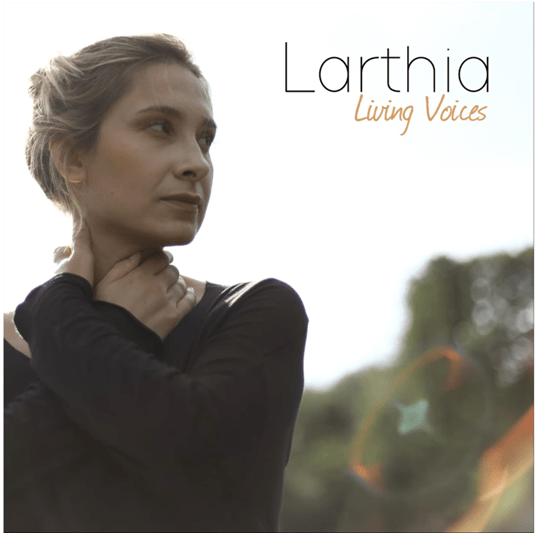
From Laura Montinari:
Songwriting Oral History Interviews: Archival Songs As Critical-Creative Pedagogy in Dialogue With Women of the Italian Resistance explores the intersection of oral history, songwriting, and critical-creative pedagogy. Drawing on archived interviews with women who participated in the Italian Resistance during World War II, I reimagined these narratives not just as historical documents but as living sources for creative memory-making and educational practice. By transforming these narratives into original songs (archival songs), I aimed to bridge archival research and contemporary songwriting as a method of critical engagement and remembrance. This approach elevates music as a tool to amplify marginalized voices, offering a dialogical and artistic approach to history that challenges traditional academic frameworks. The dissertation situates songwriting as a form of embodied scholarship, emphasizing how creative methodologies can foster deeper connections to historical memory while co-constructing and re-constructing historical memory. It serves both as a means of historical preservation and as an innovative pedagogical model.
Link to my dissertation
Link to the first single taken from the research songs album
MEM – Centre des Mémoires Montréalaises, “The Making of a Community-Based Museum Rich in Oral History”
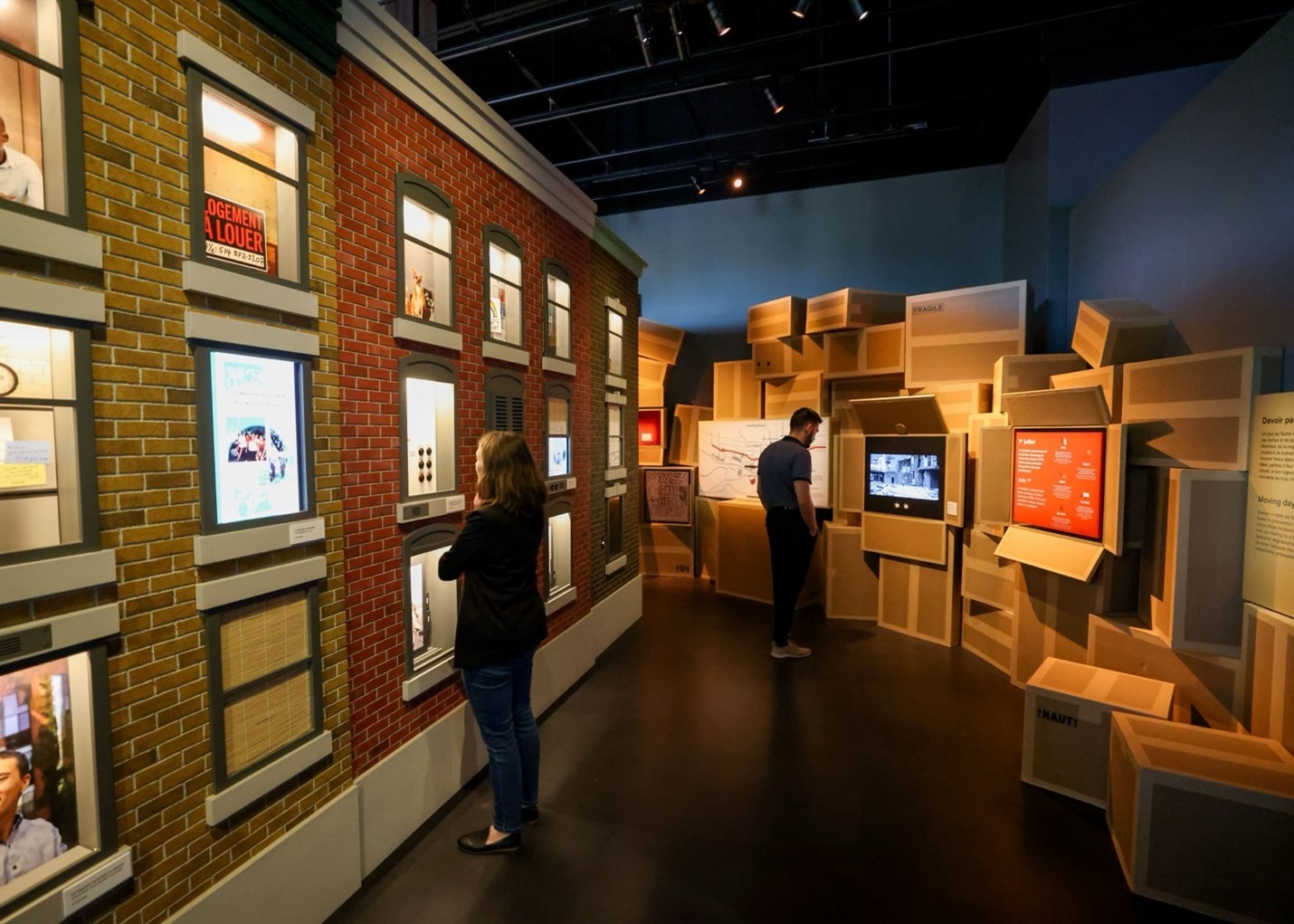
About the MEM:
The MEM – Centre des mémoires montréalaises opened its doors to the public in the fall of 2023. The MEM mobilizes Montréal’s inhabitants, who in turn help highlight the value of the city’s plural identities. We collect and present first-hand accounts from a range of communities to tell the history of Montreal.
The MEM’s mission is to celebrate Montréal’s diverse identities and histories through relatable, authentic and inclusive experiences where citizens share their stories and discover those of others.
To carry out its mission, the MEM prioritizes citizens’ voices, past and present. We capture the essence of “Montreality” — the many different facets of the city in all their diversity. Whether you hail from Montreal or have adopted the city as your own, you’re part of its history. The MEM wants to hear your voice and share your memories.
About the project:
Founded by the City of Montreal in 1983, the Centre d’histoire de Montréal (CHM) evolved in the 2000s to include diverse voices through community outreach, exhibitions, and educational programs. In the 2010s, it adopted a new mission—You’re the history of Montréal and we’re going to talk about you—placing oral history and citizen participation at the heart of its work. This approach gained momentum with the official announcement in 2016 of the museum’s relocation to a new building in the heart of downtown. Community co-creation became central to its philosophy, ultimately leading to the creation of the MEM.
Since opening in 2023, the MEM has fully embraced oral history as the foundation of its mission and programming. All of its projects are rooted in citizen voices, with two dedicated spaces showcasing grassroots content created by, for, and with Montrealers. Committed to amplifying underrepresented perspectives—such as those of women, Indigenous peoples, ethnic communities, and marginalized individuals—the Museum added 95 new interviews to its collection as part of its oral history initiative for public spaces and the permanent exhibition. This resulted in 86 audio and audiovisual capsules. Today, the MEM’s permanent collection includes nearly 900 oral history interviews, reflecting the city’s rich and diverse narratives.
In addition to the museum’s permanent spaces, inaugural projects such as Détours – Urban Experiences, its first major temporary exhibition, invite visitors to discover Montréal through the eyes of its citizens, highlighting personal stories and unexpected urban encounters. The immersive experience A Mile in My Shoes offers a deeply empathetic experience, allowing participants to literally walk in someone else’s shoes while listening to their story. The community exhibition space -the Kiosque – regularly features community-led initiatives and exhibitions, ensuring a continuous presence of citizen-created content.
Located in the heart of a city of four million people, the MEM is a space that is both accessible and attuned to the many realities of Montreal. In its effort to bring Montrealers together around authentic, local histories, a third of its spaces—including exhibition areas—are free to visit, and a wide range of cultural activities are offered at no cost.
The portal for submissions for next year’s Mason awards will open early in 2026. The deadline for entry is July 1, 2026.