
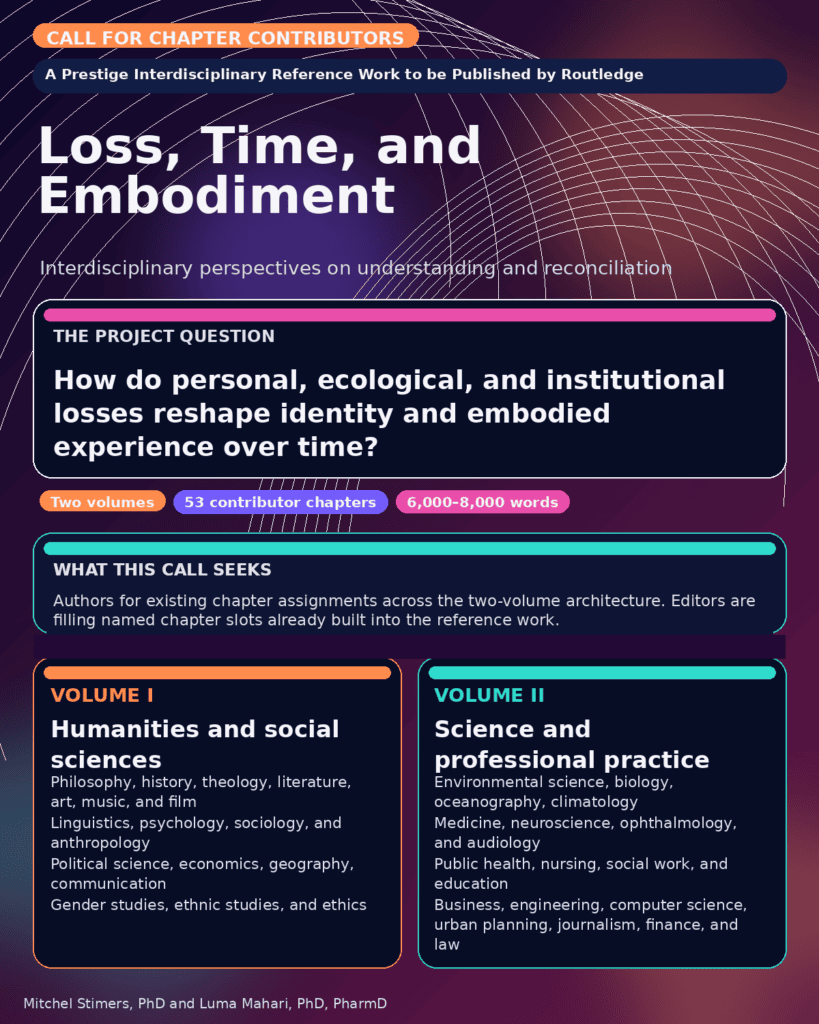
CALL FOR CHAPTER CONTRIBUTORS
Loss, Time, and Embodiment: Interdisciplinary Perspectives on Understanding and Reconciliation
Mitchel Stimers, PhD & Luma Mahairi, PhD, PharmD, Editors
We are seeking a contributor for the following chapter in our forthcoming two-volume interdisciplinary collection:
Volume I: Humanities and Social Sciences: Chapter 2: History: Erasure, Memory Wars, and Historical Grief
This collection is built on a conviction that loss takes genuinely different forms depending on the disciplinary position from which it is observed. We are not looking for a chapter that applies history to the topic of grief. We are looking for a scholar who can write from inside the discipline’s own way of seeing: one for whom the archive, the gap in the record, the contested account, and the silenced testimony are not illustrations of loss but the terrain in which a specific form of loss becomes visible in the first place.
History and oral history bring to this collection something no other field can offer: the capacity to show how loss is structured into the record itself, how erasure operates not only as an event but as an ongoing condition of what can be known, remembered, and mourned. The discipline encounters grief not as a private emotion but as a collective and political phenomenon, one whose weight accumulates across generations precisely because it was never acknowledged in its own time. Whether the chapter engages the suppression of testimony, the destruction of archives, the rewriting of official memory, contested monuments and memorials, or the communities whose losses were never entered into the historical record, the discipline’s encounter with loss should drive the argument rather than illustrate it. Oral history’s particular contribution, the recovery of testimony that the written archive could not or would not hold, makes this chapter’s terrain especially immediate for members of this community.
The collection asks each contributor to engage two anchoring concepts. Embodiment means that loss is not only a cognitive or emotional event but something that happens to bodies, structures, and material worlds, leaving traces that alter what can be perceived, inhabited, and remembered. Temporality means that loss disrupts the relationship among past, present, and future in ways that resist being located at a single moment on a timeline. For history, temporality is particularly pointed: losses that were never mourned in their own time do not stay in the past. Their weight accumulates, resurfaces, and reshapes the present in ways the discipline is uniquely equipped to trace. Contributors are not required to engage these concepts philosophically, but the chapter should reflect awareness of how the discipline’s encounter with loss is shaped by both.
The collection is designed to be read across disciplines. Contributors are asked to write with enough clarity that a careful reader outside history can follow the argument, without flattening the disciplinary perspective to reach that reader.
Full chapter description, contributor guidelines, word count, timeline, and submission details are available at: tinyurl.com/stimersmahairi