
A Reflection by OHR Editorial Board Member Lauren Kata and OHA Council Member Fanny García
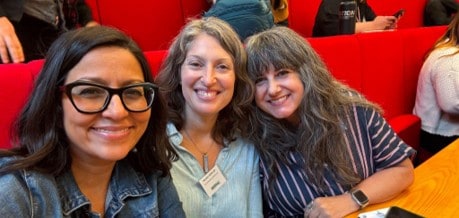
OHA members Fanny Garcia, Natalie Milbrodt, and Lauren Kata met up at this year’s OHS Festival in Nottingham, England.
Traditional oral history conferences are foundational to our field. They are essential spaces where research is shared, members network, and meaningful, intellectual sessions take shape. The structured environment of a conventional conference center or hotel ballroom provides the scale necessary to bring hundreds of practitioners together under one roof.
However, because oral history is an inherently adaptive, human-centered practice, there is also immense value in experimenting with how we gather.
In July, the Oral History Society (OHS) Festival 2026 in Nottingham, England offered a fun, intentional departure from the traditional multi-day conference model. Held in partnership with Nottingham Trent University and the East Midlands Oral History Archive (EMOHA), the event was explicitly designed to cultivate a different kind of energy: one focused less on formal paper presentations and more on kinetic, community-driven collaboration.
From conversations with OHS leader Mary Stewart of the British Library, we learned that this “Festival” concept, which originally launched as a one-day experiment in 2024 in London, was envisioned as an alternate-year companion to traditional conferences. The goal wasn’t to replace the formal conference, but to complement it, in an “every-other-year” format.
Mary noted that by condensing the event into a single, high-intensity day and anchoring it within a local university rather than a commercial conference center, the organizers lowered the financial and logistical hurdles for attendees. While the UK context differs, of course, from the geographical realities of the US, we appreciated how the OHS explicitly designed the Festival to address barriers to participation.
The schedule was carefully streamlined to maximize connection. The community-building actually kicked off the night before the conference with an informal pub meetup, which sparked early connection before the formal program even began. The Festival day itself featured a collective welcome session, parallel tracks of immersive workshops, and a substantial hot catered buffet lunch where folks from different types of oral history practice could mingle.
As three Americans joining the Festival, Lauren, Fanny and colleague Natalie Milbrodt met up in Nottingham to experience the OHS event together.
Something we noticed and remarked on was the prominent role of freelance/independent oral history practitioners and researchers who facilitated many of the Festival sessions. Freelancing in oral history means navigating the hyper-local realities of short-term heritage grants, building community trust from scratch, and managing the ethical complexities of co-creation without a university legal team behind you. Because the Festival elevated these non-institutional voices, the sessions naturally drifted away from the traditional “presentation of findings” style. Instead, they became collaborative workshops focused on the vulnerable, practical, and emotional realities of our craft, as well as other concerns such as funding and sponsorship realities, family project dynamics, and local differences.
This has real payoffs. It opens the field to people trained in social work, gerontology, and disability studies, whose questions don’t usually come out of an academic department. Several of the practitioners we met had no academic affiliation at all. They were doing contract work for foundations serving dementia patients and the Down Syndrome community, and for them oral history wasn’t a scholarly method so much as a way to sit with someone and acknowledge their dignity and right to participate in dialogic exchange. That kind of work doesn’t show up much in academic oral history literature, but it’s some of the most inventive listening happening in the field right now.
Many of the sessions were also distinctly kinetic. Facilitators actively pushed against the expectation that attendees should remain passively seated in rows for ninety minutes. Instead, we were invited to move around the room, interact with physical objects, listen to excerpts, and engage with each other.
That shift from talking at each other to talking with each other did something to the room. It gave us a structure for actually troubleshooting ideas together, without the pressure of landing on a “correct” answer, and instead let us sit with different, sometimes conflicting, perspectives long enough to actually hear them. It’s a small design choice, but it changed what kind of conversations were even possible.
It also built relationships in a field that’s more solitary than people assume. Oral history gets talked about as inherently collaborative, but a lot of the actual work happens alone: writing grant applications, designing project scopes, doing the administrative slog that never makes it into the interview room. Having a room full of practitioners moving around, talking through problems together, was a rare chance to do the work out loud instead of at a desk by yourself.
Inside the Workshop-Style Sessions
The workshop-style engagement kicked off during Track 1, when we attended “Re-using oral history archives: fears, failures and shared authority,” presented by independent researchers from the University of Leicester and Nottingham Trent. After examining a real-world interview that involved complex dynamics, attendees were broken up into different tables to reflect on prompts about how shared authority did and didn’t operate in the example, and what other ethical issues using this interview might evoke. This set our table up for a great discussion where we each drew on our own work while also examining the example provided. It was a chance to consider the anxieties modern researchers face when interacting with legacy collections captured decades prior. This session was a great, interactive way to kick off the gathering.
In the next track, we chose to attend freelance practitioner Lisa Kerley’s moving session titled “Reaching Into Memory.” Kerley shared her insights from a National Lottery Heritage Fund project where she recorded life stories of individuals living with dementia. Rather than relying on a scripted presentation, Kerley – whose project partnered with a local museum – brought out suitcases of objects from the museum that are used in educational programs, immersing attendees in group “reminiscence” moments using the physical objects to trigger sensory recollections, which we shared with each other. We were then invited to consider what types of questions we might prepare for narrators connected to the objects and what we experienced ourselves.
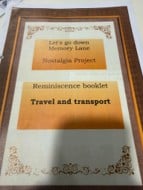

Handouts from the “Reaching Into Memory” session.
Lisa shared how tools she created such as “memory booklets” aided in her work with narrators with dementia, allowing her to provide some structure and comfort level for a vulnerable population.
Of everything on offer, this was the most inventive session of the day. It was a reminder that objects and photographs aren’t just useful for narrators with cognitive decline, they can unlock a story for anyone who doesn’t quite know how to start telling it. One piece of Lisa’s process stuck with us: the booklets aren’t the end point. After a session, she goes back into the museum’s archives and other library collections to track down actual images tied to whatever memories came up, so the narrator can eventually see a visual match for what they described.
Later in the day, we joined Track 4’s “Accents and Dialects” session, which kicked off with a brilliant, interactive listening exercise. The facilitators played a diverse range of recorded voices all answering the exact same prompt question, transforming the room into a gamified listening lab as attendees tried to guess exactly where each speaker was from. As American practitioners, this exercise was understandably a masterclass in UK regional phonetics—we managed between us to get maybe only two or three answers right! However, the playful opening served as a perfect springboard for a more critical methodology session. Once the audio guessing game concluded, the group pivoted to tackle the complex, practical challenges of representing spoken identity in archival records.
These were difficult questions to answer. With a “fill in the blanks” form projected on the screen, the room parsed through the pros and cons of phonetic transcription versus standardized text, weighing how easily an attempt to capture regional syntax can accidentally look caricatured on the page and can trigger misunderstandings and negative connotations about regional identity. We also wrestled with the tracking of accent and dialect markers in metadata, considering how to make speech variants searchable for researchers without over-labeling or pigeonholing the speakers. It was an excellent, nuanced conversation that consistently prioritized the narrator’s ultimate comfort and agency above institutional convenience.
This exercise also pushed us to confront how much bias shapes transcription choices, and a lot of that bias runs straight through race, class, and power. Someone with a Cockney accent, for instance, might not want that identity marked at all, simply because of the stigma society has attached to it.
Whose bias, exactly, is doing the choosing is worth sitting with, too. The transcriber’s ear rarely shares the narrator’s regional or class background, so the “neutral” choice on the page is almost never actually neutral. And the stakes aren’t just about protecting narrators from stigma in the moment, they’re about permanence. A phonetic transcription freezes a version of how someone sounded at a single point in time, which gets complicated for narrators who code-switch, or whose accent has shifted over a lifetime, long after they’ve stopped relating to that version of themselves. Power runs in both directions here, too. Prestige accents get quietly standardized into “proper” text without anyone treating it as a decision, while regional or working-class speech is the only kind that ever gets flagged as needing special handling in the first place. And underneath all of it is a consent question we didn’t fully resolve: whether narrators get any say in how their own speech is represented on the page, or whether that call gets made for them, after the fact, by whoever’s transcribing.
It would have been great to have had more time together to work out these questions and issues, and more practice in thinking about accent and dialect within a hive mind.
Spotlight: Tangible Archives and Tactile History
A pinnacle of this year’s hands-on philosophy was found in the special session conceptualized by Kate O’Neill for the Archives Special Interest Group (SIG). Titled “Oral history recording and archiving across the decades,“ this session was built as an interactive drop-in workshop carousel, where O’Neill and her team set up a multi-station room that invited us to walk around and physically engage with analog media.
At one station, attendees were actually invited to learn how to splice magnetic tape using editing blocks and blades, replicating the exact, meticulous process editors relied on in the old analog radio days. Next to it, the SIG had meticulously prepared a “listening station” using physical magnetic cassette tapes. They had loaded these cassettes with audio clips of speeches and interviews from formative former OHS leaders, including the foundational Paul Thompson. There was something grounding (and nostalgic) about picking up a cassette tape, popping it into a physical player, sitting down, and listening to the voices that shaped our field through headphones.
It was at the cassette station that Fanny met Margaret. Some of the interviews playing there were difficult to hear, so they gave up on them and started talking instead. Margaret has spent years in public sector leadership, in both the UK and New Zealand, and she brought a question to our conversation that she’d clearly been carrying for a while: should all experiences be documented? She’s been trying, on and off, to record her mother-in-law Anne’s story, one that touches on real historical moments, but she keeps circling back to whether she’s actually the right person to be the one interviewing her.
She wrestles with whether she has the authority, objectivity, and skill to document Anne’s oral history — and whether she is doing it for Anne or for herself. Every oral historian confronts this question when we recognize that the same skills we use to document other people’s lives can document the lives of our families and ourselves.
In fact, Fanny told Margaret about her own memoir project, about her family’s immigration story, and how she keeps running into the same wall from the other side, trying to figure out what she owes the public and what she gets to keep for herself.
Talking with her, Fanny realized how rarely this kind of exchange happens at academic conferences. There, people ask about the project, the publications, and the next deliverable—the tangible outputs of oral history work. Almost no one asks what the work is doing to you, or what it costs you to decide how much of yourself to give to the work and the people you collaborate with.
As a member of the OHA Archives Caucus Metadata Working Group, a final station in the Archives SIG session that resonated with Lauren was the interactive oral history metadata “dot-voting” exercise. Participants were invited to choose their “top 6” pieces of information critical for project handovers. This reminded her very much of the Metadata Group’s 2017 exercise in Montreal, where session attendees were invited to pick, categorize, and place along the windows “important metadata elements” for oral history. This crowdsourcing interactive session was also reminiscent of the OHA annual meeting where between sessions, organizers printed out physical booklets of historic conference photographs and left them on tables, inviting attendees to collaboratively crowd-source captions and identify faces. The OHS Archives SIG session was entirely in the spirit of that cross-Atlantic interactivity. It proved that when we give practitioners tactile, physical ways to interact, engagement skyrockets.
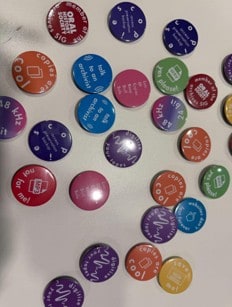
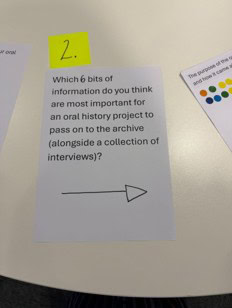
Interactive Activities were in abundance at the OHS Archives SIG session.
Final Thoughts
This meeting was a valuable model demonstrating that our professional gatherings do not have to choose between institutional rigor and grassroots accessibility. Traditional, multi-day conferences remain vital for academic professional exchange and macro-level networking. By occasionally stepping into the complementary “Festival” model, with its localized venues, single-day schedules, interactive workshops and deliberate spotlight on the insights of independent practitioners, we can cultivate a joyous, engaging space. And the tactile sessions were an incredible success. Bringing back analog media, encouraging listening moments and physical crowdsourcing exercises, we aren’t just talking about oral history, we’re touching it. The Festival is a format that reminds us that oral history is not just an abstract discipline, but a living, breathing, collaborative practice of community memory. It merits replicating in the US, perhaps hosted by the Oral History Association, the Oral History in the Mid-Atlantic Region or another organization that centers oral history practice.
We look forward to hopefully returning to the next Festival in 2028! Thanks, OHS!